
How to handle jet lag on long-haul flights easily
Trippwiz Editorial
08 Jun 2026 • 12 min read
How to handle jet lag on long-haul flights easily
Most travel advice tells you to start shifting your bedtime three days before a flight. Let's be honest: that is practically impossible for anyone with a job, kids, or a life. Forcing yourself to go to sleep at 7:00 PM on a Tuesday because you are heading to Paris on Friday is a recipe for frustration, not a solution for circadian rhythm disruption. In my experience, the obsession with pre-flight preparation often creates more stress than the travel itself. I once spent a week in mid-2024 trying to "pre-adjust" for a trip to Tokyo by waking up at 4:00 AM in New York, and by the time I boarded the plane, I was already so exhausted that the actual jet lag felt twice as heavy. The real secret to how to beat jet lag isn't about becoming a shut-in before you leave; it's about strategic lighting, chemical timing, and absolute discipline the moment you touch the tarmac.
Key Takeaways
-
Light is the primary lever: Controlling your exposure to blue light and sunlight is 90% of the battle when resetting your internal clock.
-
The "First Meal" Rule: Eat your first meal at the destination's breakfast time, even if you aren't hungry, to jumpstart your metabolic clock.
-
Strategic Supplementation: Use 0.5mg to 3mg of melatonin only when your destination's sun goes down, not just when you feel tired on the plane.
To successfully navigate a 10-plus hour journey across multiple time zones, you need more than just a neck pillow. You need a physiological game plan. While most advice focuses on comfort, we are going to focus on your suprachiasmatic nucleus, the part of your brain that actually controls your sleep-wake cycle. In 2026, with the rise of ultra-long-haul routes like New York to Sydney, the margin for error has narrowed. If you don't manage your biology, you'll lose three days of your trip to a brain-fogged haze. The goal is to trick your brain into believing it is already in the new time zone before your feet even touch the ground.
1. Adjust your mental clock forty-eight hours out
You don't need to change your entire life, but you do need to change your perspective. Most people wait until they are sitting in the terminal to look at the local time of their destination. This is a mistake. Two days before your departure, download an app like Timeshifter. This tool uses NASA-level circadian science to tell you exactly when to seek light and when to avoid it based on your specific flight itinerary. By following a plan that starts slightly early, you begin the hormonal shift without the radical lifestyle changes that usually fail.
One common screw-up is the "sleep bank" myth. People think if they sleep 12 hours the night before a flight, they can power through the journey. It doesn't work that way. Sleep is not a checking account; you can't deposit extra hours for later use. In fact, oversleeping before a flight can make you less tired when you actually need to sleep on the plane to align with your destination. Keep your normal schedule, but start hydrating like it's your job. I aim for at least 3 liters of water daily starting 48 hours before take-off. This ensures your mucous membranes are prepared for the 10% humidity levels inside a Boeing 787 Dreamliner or Airbus A350 cabin.
When you are booking connecting flights, try to schedule layovers that allow for a quick walk in a terminal with natural light. Even twenty minutes of movement in a bright terminal can help signal to your body that it is "daytime," even if your brain is screaming for a nap. The physical movement also helps prevent deep vein thrombosis, which is a much bigger risk on these marathon hauls than most realize.
2. Managing light and melatonin during the flight
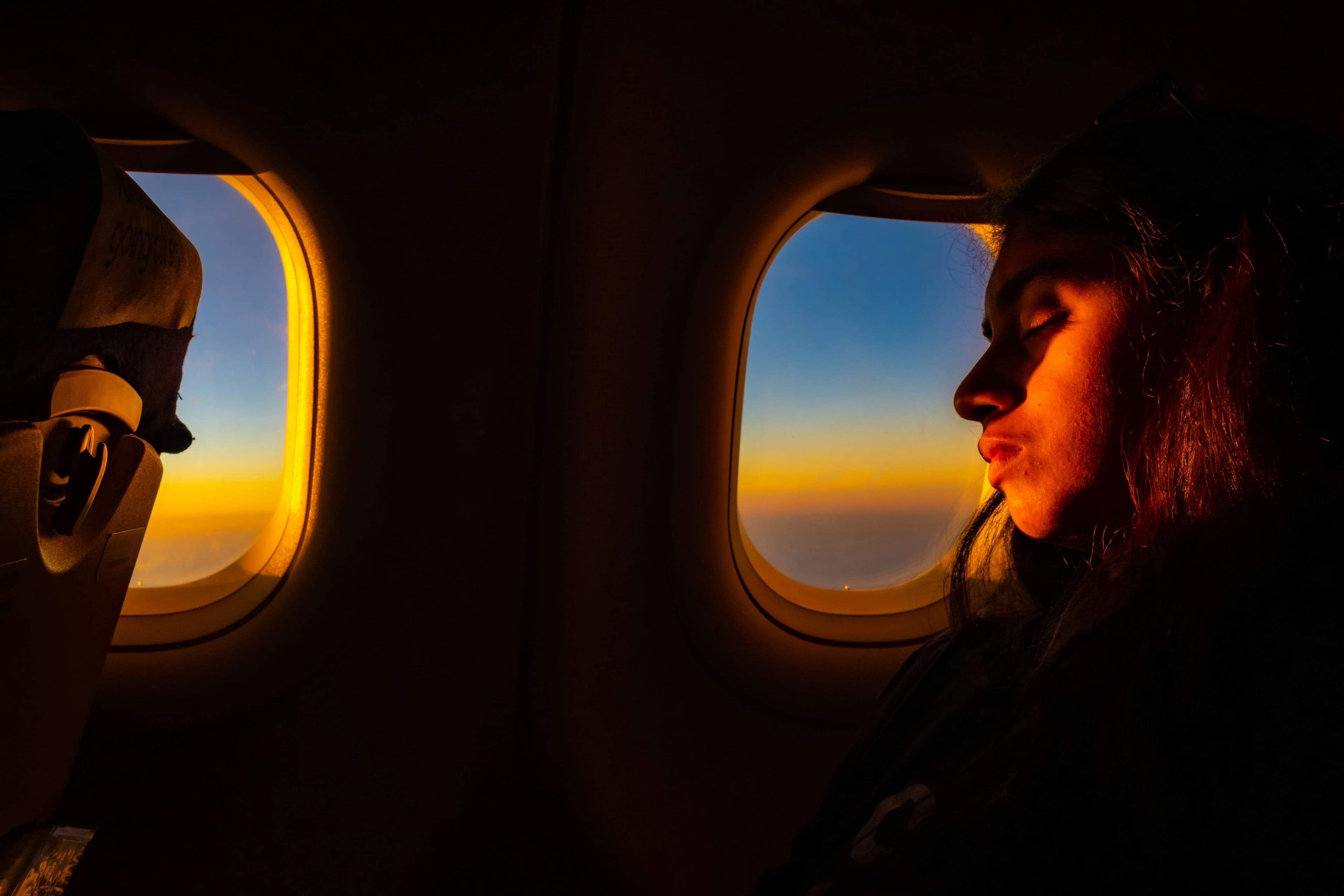
The moment you sit in your seat, your watch should be set to the destination time. This is your new reality. If it is 2:00 PM at your destination, do not close your eyes, even if you are flying through a dark night over the Atlantic. This is where most travelers fail. They see the cabin lights go down and think, "Great, time for a movie and a nap." If you do that, you are reinforcing your old time zone's rhythm. You must stay awake until it is evening in your destination city.
How to beat jet lag while in the air requires aggressive light management through the use of blue-light blocking glasses or high-quality eye masks. If you need to stay awake because it's daytime at your destination, use the brightest setting on your tablet or keep your window shade open. If it is supposed to be night, use a total-blackout mask like the Manta Sleep Mask. I've found that even the tiny LED light on the overhead console can be enough to suppress melatonin production in sensitive individuals.
Let's talk about melatonin. Most people take too much. Taking 10mg of melatonin is like hitting your brain with a sledgehammer; it often leads to "melatonin hangovers" that leave you groggy the next day. A 2022 study from MIT found that doses as low as 0.3mg are often more effective for circadian shifts. Take a low dose when it is roughly 8:00 PM at your destination, regardless of where the plane is. This signals the "opening of the sleep gate." Avoid the temptation of the free wine cart. Alcohol might help you fall asleep, but it fragments your REM cycles and dehydrates you, making the physical symptoms of jet lag significantly worse upon arrival.
3. The metabolic hack of destination-timed eating
Your brain isn't the only thing with a clock; your gut has one too. This is a nuance many guides miss. Your digestive system expects food at specific intervals. If you eat a heavy "dinner" on the plane when it's actually 4:00 AM at your destination, you are essentially telling your liver and stomach to stay on your home time zone. This creates a "metabolic lag" that contributes to the bloating and fatigue associated with long-haul travel.
The 2026 travel standard for savvy flyers is the "fasting protocol." Try to stop eating about four hours before your destination's breakfast time. When the flight attendants bring around that soggy omelet or fruit plate that aligns with the local morning, eat it. This tells your body, "This is when the day starts." This insulin spike helps reset your peripheral clocks, which are just as important as the master clock in your brain. When I flew from San Francisco to Singapore last March, a grueling 17-hour flight, I skipped the mid-flight "snack" and waited for the 6:00 AM breakfast. I felt 40% more alert upon landing than I usually do on that route.
For first-time international travelers, the sensory overload of a long-haul flight can make you forget to eat or drink properly. Keep a pack of electrolyte powder, like Liquid I.V. or LMNT, in your carry-on. The sodium and potassium help your cells retain water in the dry cabin air, preventing the "dried-out" feeling that makes jet lag feel like a physical illness.
4. Immediate sunlight exposure after arrival
What is the fastest way to prevent jet lag after an international flight? You must get at least 20 minutes of direct, unfiltered sunlight within the first two hours of landing if it is daytime. Do not wear sunglasses. You need that photons-to-retina connection to tell your brain to stop producing melatonin and start producing cortisol and serotonin. This is the single most effective "reset" button in existence.
If you arrive at 7:00 AM and you feel like death, the biggest mistake you can make is going to your hotel and taking a "quick nap." That nap will inevitably turn into a four-hour coma, and you will be wide awake at 3:00 AM the following morning. If you absolutely must rest, limit it to a 20-minute power nap before 12:00 PM. Anything longer or later will anchor your rhythm to the wrong side of the clock. Instead of napping, go for a walk. The combination of light and physical activity increases blood flow and helps clear the adenosine buildup in your brain.
In 2026, many high-end hotels in major hubs like London, Dubai, and Singapore are offering "circadian lighting" in guest rooms. If your room has this, use the "Energize" setting during the day. If not, open all the curtains. If you arrive at night, do the opposite: keep the lights low, avoid your phone, and take a warm shower. The drop in body temperature after you get out of a warm shower mimics the natural cooling the body undergoes before sleep, helping you drift off even if your mind is still racing.
Should you use "Jet Lag Pills"?
There is a lot of marketing around homeopathic jet lag remedies. Let's be clear: most of these have zero scientific backing. However, some travelers swear by No-Jet-Lag, a combination of Arnica Montana and Daisy. While the clinical evidence is thin, the placebo effect is a powerful tool in travel. If it helps you stick to a routine, use it. But don't rely on it over the fundamental pillars of light, food, and hydration. My contrarian take? Most "jet lag recovery" supplements are just overpriced vitamins. You are better off investing that money in a pair of high-quality noise-canceling headphones like the Sony WH-1000XM5, which reduce the "noise fatigue" that complicates recovery.
5. Troubleshooting common jet lag recovery issues
Even with the best plan, things can go sideways. Maybe your flight was delayed six hours, or you had a screaming infant in the seat behind you. If you find yourself wide awake at 2:00 AM in a foreign city, don't lie in bed staring at the ceiling. This creates an association between the bed and wakefulness. Get up, do some light stretching, or read a physical book (no screens!).
One common mistake is over-caffeinating to stay awake. If you drink a double espresso at 4:00 PM to survive until dinner, you'll still have caffeine in your system at midnight. Stop all caffeine intake by 12:00 PM local time during your first three days. This allows your natural sleep pressure to build up. If you're struggling with "brain fog," try a cold shower. High-performance travelers use cold exposure to trigger a dopamine spike and increase alertness without the jitteriness of coffee.
If you are traveling for business and have a high-stakes meeting the day after arrival, consider the "Eastward vs. Westward" rule. Research from the American Academy of Sleep Medicine suggests that traveling East is significantly harder on the body than traveling West. When going East, your day is shortened, which is harder for our natural 24.2-hour internal clock to adapt to. Give yourself an extra day of "buffer" time for Eastward trips if possible.
How long does it take to fully recover from jet lag?
The general rule of thumb is that it takes approximately one day of recovery for every time zone crossed. If you fly from New York to London (5 time zones), expect to feel "off" for about five days. However, by using the protocols outlined here, particularly the light exposure and fasting, you can often cut that time in half. By day three, you should be functioning at 90% capacity. Do not expect to be perfect on day one; give yourself grace and plan lighter activities for the first 48 hours.
I remember a trip to Sydney where I ignored these rules. I landed, ate a massive burger, took a 3-hour nap at 2 PM, and spent the next four nights watching infomercials in my hotel room until dawn. It ruined the first week of my vacation. Since then, I've been a stickler for the "no nap" and "direct sun" rules. It's painful for the first 12 hours, but it saves the next 12 days. Discipline on day one is the price you pay for a successful trip.
For more detailed scientific data on how light affects our sleep cycles, you can reference the Sleep Foundation's comprehensive guide on jet lag. They provide excellent breakdowns of the biological mechanisms at play. Additionally, the CDC Yellow Book offers official medical advice for international travelers that is updated regularly to reflect the latest travel health trends (as of 2026).
Navigating the world is one of life's greatest privileges, but the physical toll is real. By treating your body like the biological machine it is and respecting the power of the sun and the timing of your meals, you can minimize the "zombie" phase of your journey. Set your watch, grab your water, and get outside the moment you land. Your future self, enjoying a sunset dinner in a far-flung locale with a clear head, will thank you for the effort. Safe travels!
Frequently Asked Questions
Is it better to stay awake or sleep on a long-haul flight? It depends entirely on the local time at your destination. If it is daytime there, stay awake. If it is nighttime there, try to sleep. Use your destination's clock as your primary guide from the moment you board to ensure your brain begins the transition immediately.
Does drinking lots of water really help with jet lag? Yes, but not for the reasons you might think. Hydration doesn't fix your circadian rhythm, but it mitigates the physical symptoms of travel, like headaches, fatigue, and dry skin, that make jet lag feel worse. A hydrated body is more resilient and recovers from the stress of a long flight much faster.
Should I take sleeping pills to sleep on the plane? Be very careful with prescription sleep aids like Ambien or Xanax on flights. These can lead to extreme grogginess upon landing and, in rare cases, "sleep-walking" behaviors in a cramped cabin. If you must use them, test them at home first and only use them if you have a clear 7-8 hour window of flight time left.
How can I help my kids handle jet lag on a long flight? The same rules apply to kids, but with more flexibility. Get them into the sun immediately upon arrival. Avoid sugary snacks during the flight, as the resulting sugar crash can mimic jet lag symptoms. Let them run around the terminal during layovers to burn off "cabin fever" energy before the next leg.
What should I eat to recover from jet lag faster? Focus on protein-rich meals in the morning (like eggs or Greek yogurt) to boost alertness through tyrosine. In the evening, opt for complex carbohydrates (like brown rice or pasta) which can help stimulate the production of tryptophan and serotonin, making it easier to fall asleep at the correct local time.

Build your interactive travel map
Track every country you've visited on a stunning 3D globe. Add photos, stories, and share your journey — all free.
Also Read
Continue exploring our travel resources.
Travel Guides
Beyond Scratch Maps: Creative Ways to Track, Document, and Share Your Travel History
From scratch maps to digital globes—this guide compares travel trackers and shows how apps like Trippwiz turn your journeys into a shareable, memory-rich visual story.
9 min read
Travel Guides
The Global Guide to Flight Compensation: How to Get Paid for Delays, Cancellations, and Overbooking
A practical, region-by-region breakdown of flight compensation rights across the EU, US, UK, and India—with exact payout rules, the critical 4-hour delay trigger, and a step-by-step DIY claims process to file directly with airlines and skip commission-hungry middlemen.
10 min read
Travel Guides
The Transit Visa Blueprint: How to Know If You Need a Visa for an Airport Layover
Do I need a transit visa for a layover? Learn the rules for airside vs landside transit, terminal changes, and TWOV rules in 2026 to avoid being denied boarding.
11 min read