
Power Bank Flight Rules Explained: 20000mAh vs 30000mAh, 100Wh, and What Airlines Actually Enforce
Trippwiz Editorial
26 May 2026 • 10 min read
If you search this topic before a trip, you usually find one-line answers that sound confident but are not very useful: "20000mAh is fine" or "30000mAh is not allowed." In practice, airline battery rules are rarely that simple. The same battery can be clearly allowed with one airline, approval-only with another, and still get flagged at security if the label is unclear.
This guide is designed to help you make a pre-flight decision you can trust. It explains why mAh alone is not enough, how 100Wh and 160Wh thresholds work, where travelers get stuck at the airport, and exactly what to check before you leave home.
If you read only one thing, read this:
- Airlines decide based on watt-hours (Wh), not mAh.
- Most 20000mAh power banks are under 100Wh and are generally allowed in cabin baggage only.
- Many 30000mAh power banks are between 100Wh and 160Wh, which is often approval-only.
- Almost all airlines prohibit power banks in checked baggage.
The details below are where mistakes happen and where you save real stress.
Why this topic creates so much confusion
Travelers usually think in mAh because that is what product listings show. Airlines and airport safety teams think in Wh because that is the international standard for lithium battery transport decisions.
That mismatch causes three common problems:
- A traveler brings a "safe" power bank based on mAh and then learns the voltage makes the Wh too high.
- A traveler knows the battery is under 160Wh but does not know their airline needs advance approval above 100Wh.
- A traveler packs the power bank in checked baggage and only discovers at drop-off that it is carry-on only.
All three are avoidable if you translate capacity correctly and check the airline-specific rule band before travel.
The only formula you need
To convert battery capacity from mAh to Wh:
Wh = mAh x V / 1000
Where:
- mAh is battery capacity from the label
- V is battery nominal voltage (commonly 3.7V for power banks)
Quick conversions travelers care about
At 3.7V:
- 10000mAh is about 37Wh
- 20000mAh is about 74Wh
- 26800mAh is about 99.16Wh
- 30000mAh is about 111Wh
This is the reason 20000mAh is usually straightforward and 30000mAh often lands in approval territory.
20000mAh on flights: usually low-risk, but not automatic
Most 20000mAh power banks are around 74Wh at 3.7V, which is well below 100Wh. On many airlines, that falls into the "allowed in cabin baggage" band.
That sounds easy, but travelers still run into avoidable issues:
- The printed label is missing or unreadable.
- The battery is inside checked baggage.
- Security asks for proof of Wh and the passenger cannot show it.
- The traveler carries multiple units and exceeds quantity guidance.
Practical decision for 20000mAh
If your bank is 20000mAh and clearly labeled:
- Keep it in carry-on, never checked.
- Keep terminals protected (especially for loose spare cells).
- Avoid carrying too many large units without checking airline guidance.
For most mainstream routes, this is the lowest-friction category.
30000mAh on flights: where policy friction starts
At common voltage, 30000mAh often converts to roughly 111Wh. That places it above 100Wh and below 160Wh.
In this zone, many airlines do not outright ban the battery, but they shift it to "approval required" or "restricted quantity" rules. That means you might be compliant in theory and still face a problem in practice if you did not get confirmation before the trip.
Practical decision for 30000mAh
If your bank is near 30000mAh:
- Treat it as approval-required unless your airline states otherwise.
- Confirm policy before travel, ideally with a written record.
- Carry it only in cabin baggage.
This is the category where pre-trip verification matters most.
What 100Wh and 160Wh actually mean
These are not random numbers. They are the thresholds airlines and safety rules frequently use to classify lithium battery risk.
Up to 100Wh
Typical pattern:
- Usually allowed in carry-on.
- Usually not allowed in checked baggage if it is a spare/power bank.
Above 100Wh to 160Wh
Typical pattern:
- Often needs airline approval.
- Often limited quantity.
- Still usually carry-on only.
Above 160Wh
Typical pattern:
- Usually not accepted in normal passenger baggage.
- May require cargo handling pathways.
These are general bands, not a substitute for airline policy. Use them as your first filter, then confirm route-specific airline guidance.
Cabin baggage vs checked baggage: non-negotiable rule for power banks
The most frequent airport mistake is packing a power bank in checked luggage.
Power banks are treated as spare lithium battery devices by most airlines. That means they should remain in cabin baggage where cabin crew can respond quickly if there is overheating or thermal event risk.
Even when your battery size is acceptable, checked placement can still lead to:
- forced bag reopening
- delay at counter
- item removal
- refusal for that item
If your bag is checked through multiple segments, this risk increases because handling points multiply.
Real traveler scenarios
Scenario 1: short-haul trip with 20000mAh bank
You are flying with one 20000mAh bank labeled 74Wh.
Likely outcome:
- carry-on accepted
- checked baggage placement rejected
- smooth passage if label is clear
What makes this fail:
- no visible label
- battery packed deep in checked bag
- damaged or swollen unit
Scenario 2: long-haul itinerary with 30000mAh bank
You are flying international with a 30000mAh bank showing about 111Wh.
Likely outcome:
- airline may require approval or restrict quantity
- airport staff may ask for airline confirmation
What makes this fail:
- relying on generic internet answers without airline-specific confirmation
- assuming one segment rule applies to all segments
- carrying multiple large banks without checking limits
Scenario 3: multi-airline connection
First leg allows your setup. Second leg uses stricter interpretation.
Likely outcome:
- issue appears during transfer or re-screening
- what was accepted earlier may be challenged later
What prevents this:
- validating each operating carrier, not just the booking carrier
- carrying proof of capacity and any approvals
The hidden variable: label quality
Travelers often do the Wh math correctly and still get stuck because the battery has weak labeling.
A useful battery label should show at least:
- mAh capacity
- nominal voltage
- Wh (if available)
If Wh is not printed, security or staff may still accept conversion logic, but clear labeling dramatically reduces friction.
If your battery has no clear marking or a damaged sticker, consider carrying an alternative unit with legible specifications.
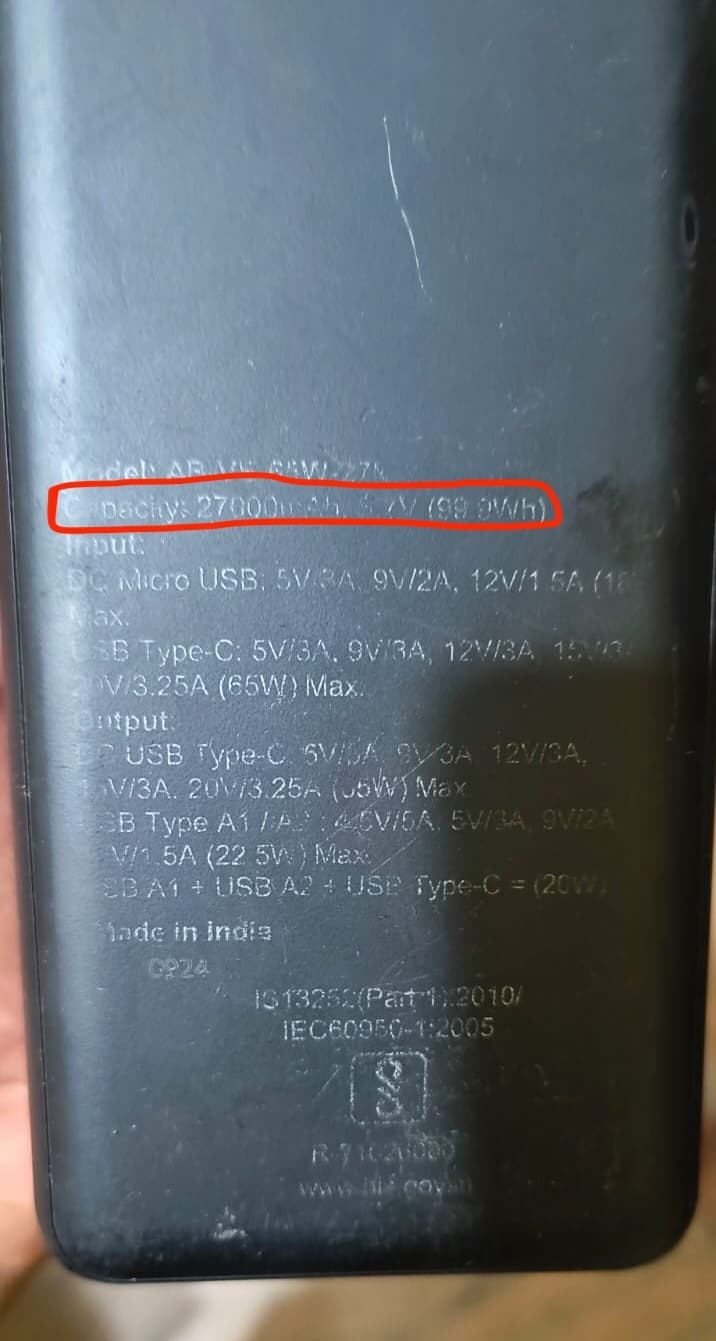
The above image shows a 27,000mAh power bank rated at 3.7V. Although this is well over 20,000mAh, it is under 100Wh [Wh = (mAh * V )/ 1000], so it is typically allowed on most airlines.
Approval-required does not mean impossible
Many travelers hear "approval required" and assume the battery is effectively banned. Not always.
Approval-required usually means:
- You need pre-travel confirmation from airline channels.
- There may be quantity constraints.
- Staff may verify at check-in or gate.
Treat this as a process task, not a gamble. A short confirmation thread can save a missed boarding argument.
Use this copy-paste template to confirm policy before travel:
Subject: Power bank approval check for booking [PNR]
Hello [Airline Support Team],
I am travelling on [date] on [flight number] from [origin] to [destination], booking reference [PNR].
I plan to carry [number of units] power bank(s) with these specs:
- Capacity: [mAh]
- Voltage: [V]
- Watt-hours (Wh): [Wh]
- Brand/model: [model name]
Could you please confirm in writing:
- Whether this power bank is allowed
- Whether airline pre-approval is required
- Maximum number of units allowed for my itinerary
- Whether it must be in cabin baggage only
- Any additional conditions I should follow at check-in/security
Thank you. I will carry your confirmation and the battery specification label during travel.
Best regards, [Full name] [Contact number]
A practical pre-flight checklist
Use this checklist 24 to 48 hours before departure:
- Confirm battery capacity and voltage from device label.
- Convert mAh to Wh and record the result.
- Check operating airline policy for your route.
- If above 100Wh, confirm whether approval is required.
- Keep battery in carry-on only.
- Protect terminals and avoid damaged units.
- Carry only the number of large units your airline allows.
- Keep screenshot or email confirmation available offline.
Most airport battery stress comes from skipping steps 3 and 4.
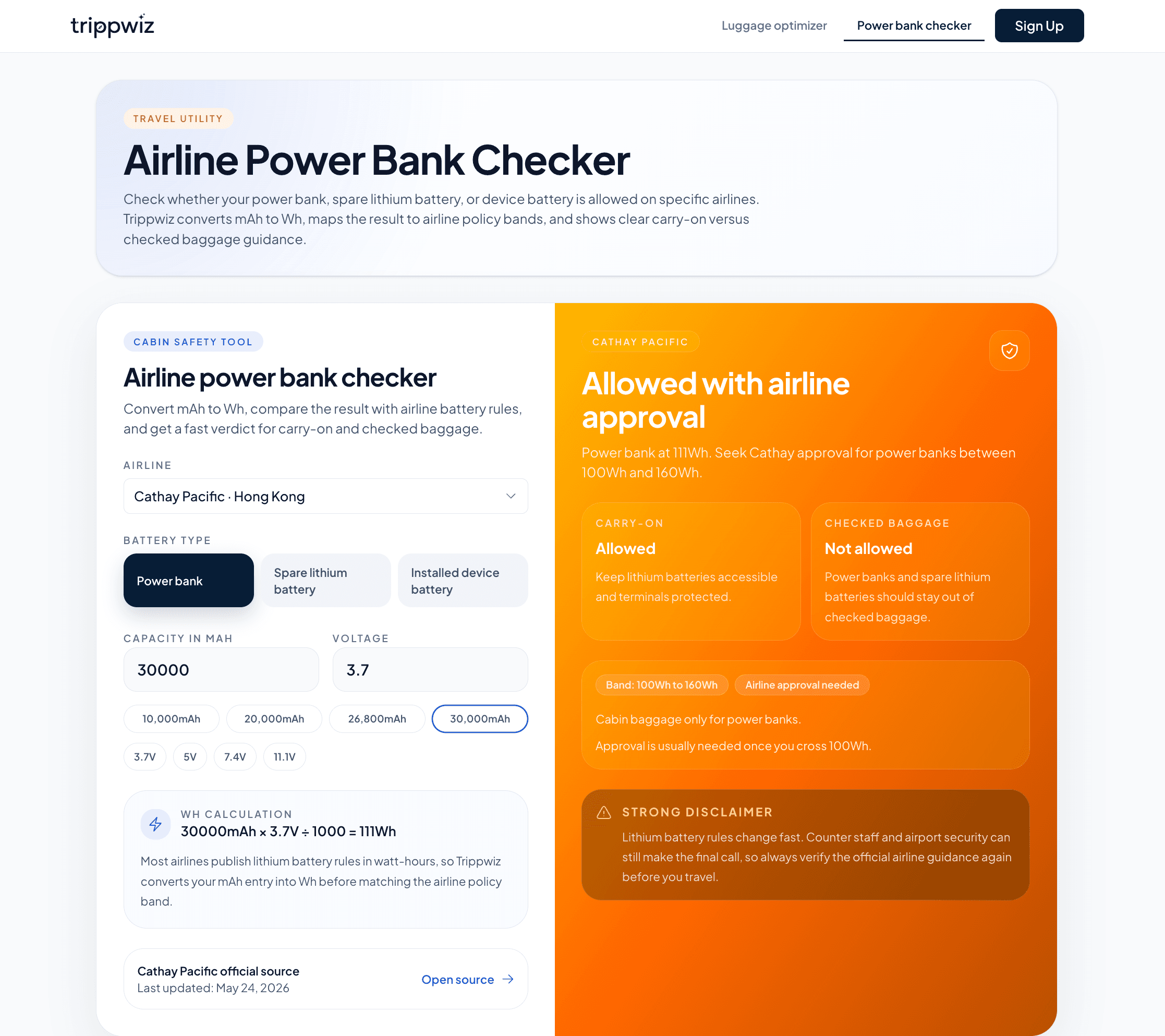
How to check your battery in Trippwiz in under a minute
If you want a fast decision before travel day, use this workflow:
- Open Trippwiz Power Bank Checker.
- Select the operating airline.
- Enter battery details from the label: mAh, voltage.
- Review the Wh band result and baggage guidance.
- If the result is approval-sensitive, use the airline contact template above and request written confirmation.
- Save the result screenshot offline for check-in and transfer points.
Example: a 30000mAh bank at 3.7V is about 111Wh, which often falls in the approval-sensitive range. In that case, do not rely on a generic internet answer. Confirm the operating carrier policy for your exact route and keep written proof.
Where online advice goes wrong
A lot of top-ranking snippets collapse everything into one sentence. That is not enough for real travel decisions.
Common bad advice patterns:
- "All power banks under 30000mAh are fine."
- "Anything under 160Wh is always allowed."
- "If one airport accepted it before, all airlines will."
These statements ignore route, operator, and approval requirements. They can be directionally helpful, but they are not decision-grade guidance.
How to choose between carrying 20000mAh and 30000mAh
If both capacities meet your travel needs, the lower-friction choice is usually 20000mAh, because it often sits comfortably below 100Wh.
Choose 20000mAh when:
- you want simplest compliance
- your usage is moderate
- you prefer fewer policy checks
Consider 30000mAh when:
- you genuinely need higher output or longer backup
- you are willing to confirm airline requirements in advance
- you can carry and document approval requirements if needed
This is not just about technical allowance. It is about operational reliability on travel day.
Carrier differences you should expect
Even within similar regions, policy wording can differ in ways that matter:
- some airlines phrase rules by Wh bands
- some phrase by "small/medium/large lithium batteries"
- some are explicit about quantity limits
- some require case-by-case approval notes
That is why a universal yes/no answer is weak content for this topic. The right answer is a route-aware, airline-aware decision process.
If airport staff decision differs from what you expected
Stay calm and practical. The goal is to continue travel, not win a policy debate at the counter.
Best approach:
- Show battery label and Wh calculation.
- Show airline policy source or prior confirmation.
- Ask for options (carry-on rearrangement, supervised handling, alternate packing).
- Avoid escalation language unless absolutely necessary.
In many cases, the issue can be resolved quickly when information is presented clearly.
Final recommendation
If you need a single actionable rule:
- 20000mAh is typically the safer travel default because it is commonly below 100Wh.
- 30000mAh can be travel-viable but should be treated as approval-sensitive and airline-specific.
For both:
- keep in cabin baggage
- confirm operator policy before departure
- carry clear battery information
That is the difference between "probably fine" and "actually prepared."
Sources and review
- Airline battery handling policies referenced through Trippwiz power-bank data framework.
- mAh-to-Wh conversion based on standard capacity formula used in passenger guidance contexts.
- Last reviewed: May 2026.
- Cathay Pacific Spare batteries Baggage Information

Build your interactive travel map
Track every country you've visited on a stunning 3D globe. Add photos, stories, and share your journey — all free.
Also Read
Continue exploring our travel resources.

Travel Guides
Beyond Scratch Maps: Creative Ways to Track, Document, and Share Your Travel History
From scratch maps to digital globes—this guide compares travel trackers and shows how apps like Trippwiz turn your journeys into a shareable, memory-rich visual story.
9 min read
Travel Guides
The Global Guide to Flight Compensation: How to Get Paid for Delays, Cancellations, and Overbooking
A practical, region-by-region breakdown of flight compensation rights across the EU, US, UK, and India—with exact payout rules, the critical 4-hour delay trigger, and a step-by-step DIY claims process to file directly with airlines and skip commission-hungry middlemen.
10 min read

Travel Guides
The Transit Visa Blueprint: How to Know If You Need a Visa for an Airport Layover
Do I need a transit visa for a layover? Learn the rules for airside vs landside transit, terminal changes, and TWOV rules in 2026 to avoid being denied boarding.
11 min read