
Weight Concept vs Piece Concept: How Airline Baggage Rules Actually Work
Trippwiz Editorial
24 May 2026 • 11 min read
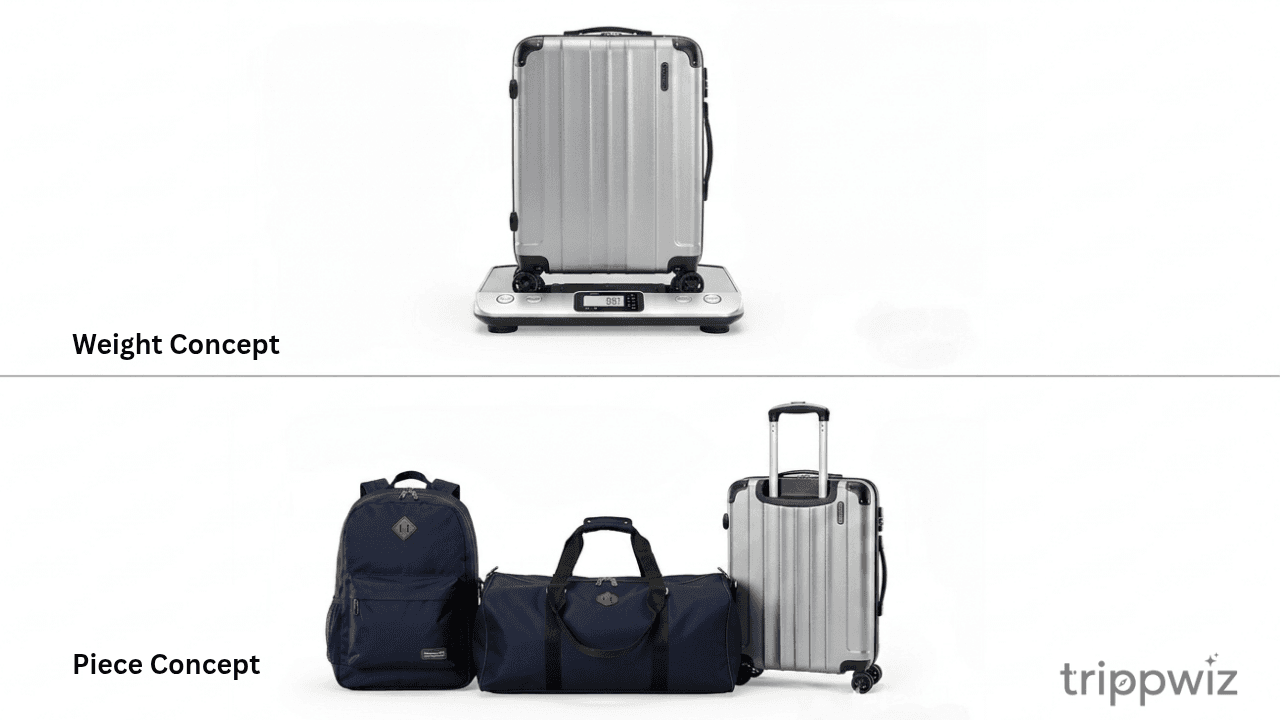
If you have ever opened an airline baggage page and felt like you were reading two different languages at once, you are not alone. One airline says your checked bag is under a weight concept. Another talks about a piece concept. A third appears to use both depending on the route, cabin, or fare family. The wording looks simple, but the practical result is where travelers either save money or get hit with a surprise at the airport.
This guide explains the difference in plain language, shows real examples, and gives you a decision framework you can actually use before you fly. It is written for people who want a clear answer, not a policy lecture.
Why this distinction matters
The baggage concept an airline uses changes the way your allowance is measured and how extra charges are calculated.
With a weight concept, the airline mainly cares about the total kilograms you are allowed to check. If you are allowed 20kg, you can usually divide that across one or more bags, as long as no individual bag breaks a separate size or safety limit.
With a piece concept, the airline cares about the number of bags, the weight of each bag, and sometimes the size of each bag. You might be allowed two checked bags of 23kg each. That sounds generous until you realize a single 30kg bag may not be acceptable even if your total weight is only 30kg.
The detail matters because the wrong assumption leads to very different outcomes:
- You may pack one heavy suitcase when the airline expects two lighter pieces.
- You may buy extra weight when the airline actually charges by extra bag.
- You may think your carry-on is fine because the total weight is fine, but the airline may reject it because one bag exceeds the allowed per-piece limit.
The short version
Here is the simplest way to remember it:
- Weight concept = total kilograms matter most.
- Piece concept = bag count and per-bag limits matter most.
That sounds basic, but it changes the entire packing strategy.
Weight concept explained with a real example
In a weight concept system, the airline gives you a total checked baggage allowance. If your allowance is 20kg, you can often use one 20kg bag, two 10kg bags, or another combination that stays within the total. The airline may still impose a maximum size per bag, but the main rule is the total weight.
Real-world style example
Imagine you are flying IndiGo on a route where the checked allowance is 15kg.
- If you pack 13kg, you are within the allowance.
- If you pack 17kg, you are 2kg over.
- If the airline charges ₹700 per extra kg, the extra fee is ₹1,400.
That is the kind of math travelers need to do before they leave home, not after they reach the counter.
Now imagine a different weight concept route where the allowance is 30kg.
You could pack:
- 1 bag of 18kg and 1 bag of 12kg
- 2 bags of 15kg each
- 3 bags of 10kg each, if the airline permits multiple pieces under the same total
What matters is the total and whether each individual bag stays under any size or handling limit.
When weight concept is useful
Weight concept can be friendlier for travelers who want flexibility. If you are packing family items, gifts, or odd-shaped gear, it is often easier to distribute weight across bags instead of trying to fit a rigid per-piece model.
But it can also be dangerous if you assume every airline handles it the same way. Some airlines use weight concept on one route and piece concept on another. Others shift rules based on fare class.
Piece concept explained with a real example
In a piece concept system, the airline gives you a fixed number of checked bags. The exact number and the weight per bag are both important.
For example, an airline might allow 2 checked bags of 23kg each.
That means:
- 1 bag of 23kg is allowed, but you are not using the full allowance.
- 2 bags of 23kg are allowed, which uses the full allowance.
- 1 bag of 30kg may be rejected, even though the total is below 46kg.
This is where many travelers get caught. They think in total weight, but the airline is thinking in pieces.
Real-world style example
Suppose you are flying Emirates on a route that uses piece concept.
If your ticket allows 2 pieces at 23kg each:
- 2 bags at 22kg each = allowed
- 1 bag at 28kg + 1 bag at 18kg = the 28kg bag may be over the per-piece limit
- 1 bag at 40kg = not acceptable, even though it is below the total 46kg
If the airline charges per extra piece, the fee is not just about kilograms. A third bag may be treated as an extra piece, and a heavy bag may be treated as both an overweight piece and a separate handling issue.
That is why piece concept demands a different packing strategy. You are not just counting kilos. You are distributing them correctly.
Why airlines use both models
Airlines do not choose a baggage concept randomly. The model often depends on route economics, cabin class, market competition, and operational simplicity.
Weight concept is common where airlines want to give flexible total baggage allowances. Piece concept is common on long-haul or intercontinental routes where standardizing by bag count makes baggage handling easier.
Some airlines also vary by fare family. For example, a basic economy fare may give less weight or fewer pieces than a higher fare class, even on the same route.
How this affects real packing decisions
If you know the concept in advance, you can pack with less risk and fewer airport surprises.
If the airline uses weight concept
Focus on total kilograms first.
Use this checklist:
- Weigh every bag before leaving home.
- Keep a margin of 1 to 2kg below the allowance if possible.
- Put heavier items in the bag that is easiest to adjust.
- Check whether carry-on has a separate limit.
If the airline uses piece concept
Focus on bag count and per-bag weight.
Use this checklist:
- Count the number of checked bags allowed.
- Check the max kg per bag.
- Avoid creating one oversized suitcase.
- Split weight evenly when possible.
This is a simple distinction, but it changes the packing result more than most travelers expect.
A practical comparison table
| Rule type | What airline tracks most | Traveler risk | Best packing approach |
|---|---|---|---|
| Weight concept | Total kilograms | Going over the total allowance | Distribute weight flexibly |
| Piece concept | Bag count + per-bag weight | One bag being too heavy | Split into balanced bags |
- Let's consider Qatar airways flying from Qatar to Australia. This route of Qatar Airways follows Weight concept, where cabin allowance is 7KG, check-in allowance is 20KG (Economy lite class). Whereas the same airline flying from Germany to South Africa follows piece-based concept with 7KG cabin allowance and 2x23 (2 bags upto 23KGs each) check-in allowance for Economy classic class.
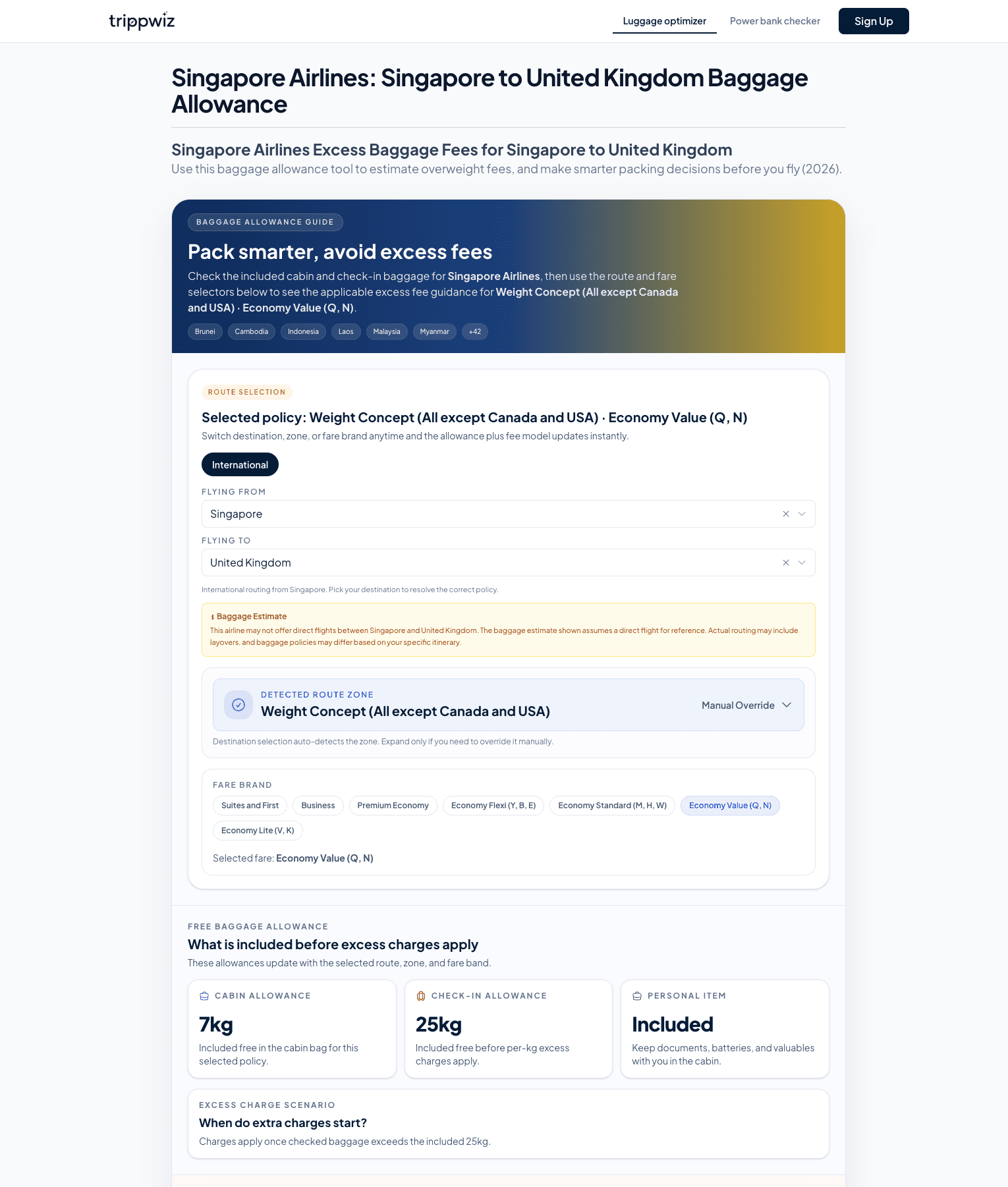
- Singapore Airlines traveling from Singapore to India follows weight based concept, allowing 7KG cabin allowance and 25KG check-in allowance for Economy Value fare brand. Whereas the same airline flying from Singapore to the United States follows piece based concept with 7KG cabin allowance and 2x32 (2 bags upto 32KG each) check-in allowance for Business class (2x23 for economy and premium economy).
Common mistakes travelers make
The most expensive mistake is not the overweight bag itself. It is assuming the concept before checking the route.
Here are the mistakes that show up again and again:
- Assuming all airlines in the same region use the same baggage model.
- Reading only the total allowance and ignoring the per-bag limit.
- Forgetting that a route-specific fare can override the default airline policy.
- Packing one heavy bag because it is easier to carry.
- Ignoring carry-on rules because the checked-baggage allowance looked generous.
That last one matters a lot for travelers carrying power banks, cameras, and laptops. A checked-baggage allowance does not automatically mean every item can be placed there.
How to decide which concept applies to your flight
Use this decision framework before you pack.
- Check the airline page for your exact route.
- Look for language like "weight concept," "piece concept," "per bag," "per piece," or "total allowance."
- Check whether the route differs by origin and destination.
- Check whether your fare class changes the rule.
- Confirm the carry-on and checked-baggage rules separately.
If the airline page is ambiguous, do not guess. Search for the route-specific baggage table or the fare family chart. If you still cannot tell, treat the rule as stricter, not looser.
Alternatively you can turn to Trippwiz's luggage optimizer tool, navigate to Tool > Luggage Optimizer or Click here. Select the airline your flying with. To get accurate data input your source/destination country and fare brand.
Trippwiz instantly calcuates and shows the allowed cabin and check-in allowance based on your route/class. In addition you can also know the excess fee and pre-pay ahead of time through the official airline page to avoid additional airport fees.
Real examples across airlines
IndiGo style example
IndiGo often uses weight-based baggage rules on many routes, which means the total checked allowance matters most.
A traveler who understands this can split baggage more flexibly. If the route allows 20kg, the traveler can use one bag or two bags as long as the total stays within the allowance and any separate bag-size limit is respected.
Emirates style example
On routes that use piece concept, Emirates may allow a fixed number of bags, and each bag must stay within the permitted per-piece weight.
That means the traveler must think in both bags and kilograms. A single heavy suitcase can become a problem even if the total baggage weight looks acceptable on paper.
Thai Airways style example
Thai Airways route rules can be especially useful for illustrating why piece concept matters.
If the route uses a piece-based allowance, travelers need to plan the bag count carefully. This is not just about buying extra weight. It is about whether the airline expects a set number of checked pieces.
What about carry-on and power banks?
This is where the two baggage concepts can mislead people.
A checked-baggage allowance, whether weight or piece based, does not mean loose lithium batteries or power banks can go into checked baggage. Most airlines treat power banks as carry-on only items, even if the checked bag allowance is generous.
So if you are carrying a power bank, think of it as a separate rule layer:
- First, check whether the airline allows the power bank in carry-on.
- Then, check whether it is below the watt-hour threshold.
- Then, check whether any approval is needed above 100Wh or 160Wh.
That is why route and battery logic should be treated as two different decisions, not one.
How Trippwiz can help readers make the decision faster
A good baggage page should not just state rules. It should help the traveler decide what to do next.
That means showing:
- the rule concept
- the allowance
- the fee logic
- a worked example
- the route context
- and a direct link to the right airline checker
When a user sees those pieces together, they can move from confusion to action without bouncing to another site.
When to be conservative
If you are close to the limit, do not pack right up to the edge unless you must. Airline counters are not the place to discover that one bag is too heavy or that the route uses a different concept than expected.
Be conservative when:
- your flight has multiple segments
- your fare is basic or promotional
- your luggage includes fragile or unevenly weighted items
- you are carrying sports gear, baby gear, or multiple small bags
Those are the situations where a little margin saves the most time and money.
Final takeaway
Weight concept and piece concept are not just technical labels. They are the difference between packing confidently and paying surprise fees.
Remember the core rule:
- Weight concept = total kilograms matter most.
- Piece concept = bag count and per-bag limits matter most.
If you understand that difference, you are already ahead of most travelers. The rest is route checking, fare checking, and making sure you do not confuse baggage rules with carry-on battery rules.
If you want to make this article even stronger later, add one or two real screenshots from airline policy pages and a short personal note from a traveler or founder about a time the wrong baggage assumption caused a problem. That kind of detail adds credibility without turning the page into filler.
Sources and review
- Official airline baggage policy pages used by Trippwiz tool data.
- Route and fare examples cross-checked against the baggage optimizer logic.
- Last reviewed: May 2026.
- Emirates Baggage policy
- Singapore Airlines Baggage policy
- Qatar Airways Bagge policy

Build your interactive travel map
Track every country you've visited on a stunning 3D globe. Add photos, stories, and share your journey — all free.
Also Read
Continue exploring our travel resources.

Travel Guides
Beyond Scratch Maps: Creative Ways to Track, Document, and Share Your Travel History
From scratch maps to digital globes—this guide compares travel trackers and shows how apps like Trippwiz turn your journeys into a shareable, memory-rich visual story.
9 min read

Travel Guides
The Global Guide to Flight Compensation: How to Get Paid for Delays, Cancellations, and Overbooking
A practical, region-by-region breakdown of flight compensation rights across the EU, US, UK, and India—with exact payout rules, the critical 4-hour delay trigger, and a step-by-step DIY claims process to file directly with airlines and skip commission-hungry middlemen.
10 min read

Travel Guides
The Transit Visa Blueprint: How to Know If You Need a Visa for an Airport Layover
Do I need a transit visa for a layover? Learn the rules for airside vs landside transit, terminal changes, and TWOV rules in 2026 to avoid being denied boarding.
11 min read